
After a fire in a commercial building, the first priorities are protecting people, securing the property, and preventing further damage. Cleanup should begin only after access has been authorized and immediate safety hazards have been assessed.
Smoke, soot, odors, and the water used to suppress the fire can affect areas far beyond the original source. HVAC systems, inventory, equipment, ceilings, walls, and adjacent spaces should therefore be inspected before normal operations resume.
Voici les premières étapes à suivre :
- Wait for authorization before entering the building.
- Secure openings and hazardous areas.
- Document the damage before moving property or inventory.
- Contact the insurance provider promptly.
- Implement the emergency mitigation measures that are immediately required.
- Have soot residues, moisture, and affected materials assessed.
- Prepare a commercial building fire cleanup and restoration plan.
After the fire department leaves, the property owner should take the necessary steps to protect the building, obtain the available incident documents, and photograph the damage once access is permitted. In a commercial property, these actions should be coordinated with the building manager, insurer, and professionals responsible for securing the site.
The first priority is not immediate cleaning. It is securing, documenting, and stabilizing the building in the right order.
Need a Post-Fire Assessment?
Describe the situation so our team can explain the first measures to consider and confirm whether an intervention is available.
Call 514-727-3415
What Should You Do Immediately After a Commercial Fire?
The first decisions can significantly affect safety, the extent of the damage, and the insurance claim process. The owner or property manager should coordinate the next steps with the authorities, insurer, and qualified professionals.
Wait for Authorization Before Entering the Building
Do not return to the building until the appropriate authorities have confirmed that entry is permitted. Hazards may remain after the fire has been extinguished, including unstable structural components, hot spots, damaged electrical systems, and areas that are difficult to inspect.
Authorization to enter does not necessarily mean that every room can be occupied or that business operations can resume normally. Some areas may remain off limits until they have been secured or further assessed.
After the fire department leaves, the owner should protect the property and follow the instructions provided by the authorities, insurer, and retained professionals. Damaged doors, windows, and other openings may need to be boarded up to reduce unauthorized entry, weather exposure, and additional damage.
Avoid Unplanned Cleaning Before the Assessment
It may be tempting to wipe down walls, sweep debris, or move inventory immediately. These actions can spread soot particles, affect damage documentation, or complicate the restoration process.
Emergency mitigation measures needed to prevent further deterioration should still be implemented promptly in coordination with the insurer and the professionals involved. Unplanned cleaning should not be confused with a carefully managed stabilization response.
Avoid the following:
- Dry sweeping soot or ash.
- Using a household vacuum or shop vacuum.
- Applying cleaning products without checking material compatibility.
- Moving contents before documenting their condition.
- Operating equipment that may be contaminated.
- Automatically restarting HVAC or other mechanical systems.
Deposited ash and fine particles can become airborne again during cleanup. Dry sweeping should be avoided. Where suitable, lightly damp methods and equipment fitted with HEPA filtration are generally more appropriate than standard household vacuums.
Photograph and Document Affected Areas
Once access is safe, photograph damaged rooms, equipment, inventory, and building materials before moving them. Take wide-angle photographs of each area, followed by close-up images of specific damage.
For a commercial insurance claim, the insurer should be contacted quickly, damaged property should be inventoried, and invoices related to emergency mitigation should be retained. Items should generally not be discarded before consulting the insurer unless they create an immediate health or safety hazard.
Keep records such as:
- Dated photographs and videos.
- An inventory of damaged property and stock.
- Available receipts and proof of purchase.
- Invoices and payment records.
- Emergency response reports.
- Work orders, estimates, and authorizations.
- Logs for installed drying or filtration equipment.
- Communications with the parties involved.
- Information related to business interruption.Daily job-site reports.
What Damage Should Be Assessed After a Fire?
Flames account for only part of the damage. Heat, smoke, soot, moisture, and firefighting operations can affect many building components.
A post-fire damage assessment should distinguish visible damage from contaminants or moisture that may have migrated into hidden or less accessible areas.
Soot Deposits and Combustion Residues
Soot can settle on walls, ceilings, floors, equipment, inventory, and elevated horizontal surfaces. Its composition varies according to the materials that burned, the temperature, airflow, and the conditions of combustion.
A structural fire can produce or release hazardous substances, including benzene, formaldehyde, polycyclic aromatic hydrocarbons, dust, and other volatile compounds. Residues should therefore be assessed before selecting cleaning methods, personal protective equipment, and materials that may be salvageable.
In an older commercial building, damaged debris, insulation, finishes, or floor and wall coverings may also contain asbestos. Suspect materials should not be cut, moved, or demolished before they have been verified. Learn more about our commercial asbestos abatement services. Consultez notre service de décontamination commerciale de l’amiante.
Not every surface can be cleaned in the same way. A method that works on metal may damage a porous, painted, or delicate material. The residue and the material compatibility should be assessed before a cleaning process is selected.
Smoke Odors and Smoke Contamination
Smoke odors can penetrate porous materials, textiles, acoustic ceiling tiles, insulation, furniture, packaging, and certain types of inventory. The severity can vary according to ventilation, temperature, and the duration of exposure.
Odor treatment begins by identifying the sources. Materials that cannot be restored should be removed, while compatible surfaces should be cleaned according to the type of smoke residue present.
The plan may also include controlled ventilation, air filtration, replacement of selected filters, and treatment of porous materials that can be retained. Temporarily masking an odor without removing the residues that cause it does not constitute complete fire damage restoration.
A weaker odor does not necessarily mean that all combustion residues have been removed.
Water and Moisture From Fire Suppression
Water used to control a fire can penetrate floors, walls, ceilings, and concealed cavities. Damage may also result from sprinkler activation, damaged water lines, or exposure to rain and snow after the building envelope is compromised.
Standing water should be extracted, and wet materials should be assessed promptly. For damage involving clean water, drying strategies are often planned within a 24-to-48-hour window to reduce the risk of mold growth. This timeframe is a guideline rather than a guarantee, since mold may still begin to grow sooner under certain conditions.
The source and quality of the water must be considered. Different measures are required when the water contains sewage, chemicals, or other contaminants. Air movers should not be installed until the team has determined whether their use could disperse contaminants.
When fire suppression water has affected a large area, consult our guide to water damage in a commercial building. dégâts d’eau dans un bâtiment commercial.
HVAC Systems and Adjacent Areas
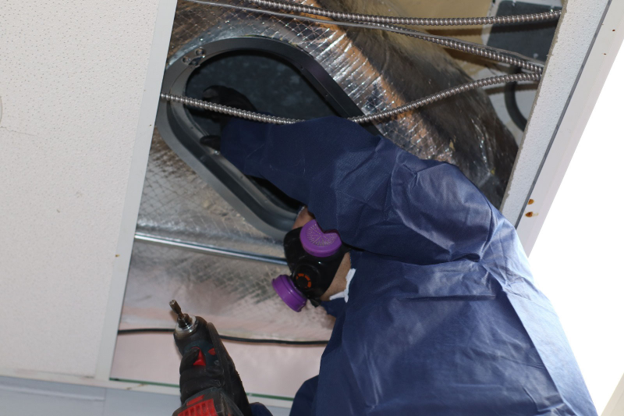
Smoke and particles can move through openings, stairwells, suspended ceilings, and mechanical systems. The assessment should consider air intakes, filters, ductwork, air handling units, and spaces connected to the affected area.
A full duct cleaning is not automatically required after every fire. The HVAC system should first be inspected to determine whether smoke, soot, or debris reached the ducts, filters, or air handling components.
Based on the findings, the scope may include filter replacement, cleaning selected components, or a more extensive system cleaning. Post-smoke-event recommendations commonly include inspecting ventilation systems and cleaning or replacing filters when necessary.
An inspection helps determine whether commercial air duct cleaning should be added to the fire cleanup scope. Our commercial air duct cleaning service .
How Does Commercial Building Fire Cleanup Work?
The cleanup plan depends on the extent of the loss, the materials that burned, the type of property, and the operations conducted inside it. A manufacturing plant, food business, warehouse, and office building do not have the same cleanup requirements.
The scope should also account for access to affected areas, occupant protection, specialized equipment, and the client's operational requirements.
Assessing Salvageable Materials
The first step is determining which materials can be cleaned, which require specialized restoration, and which must be removed.
The assessment may consider:
- The depth of contamination.
- The porosity of the material.
- Heat-related damage.
- The presence of water or moisture.
- The function of the item or equipment.
- Health and sanitation requirements specific to the business.
- The cost and feasibility of restoration.
- The terms and limits of the insurance coverage.
High-value contents, specialized equipment, and important documents may require professionals with specific restoration expertise.
The decision to clean, repair, or replace property depends on the type of damage, its condition, and the terms of the insurance policy. The exact process can vary according to the loss and the insurer.
Soot Removal From Compatible Surfaces
Cleanup generally begins by protecting unaffected areas and limiting the spread of soot particles. HEPA vacuuming, wiping, washing, or specialized cleaning methods may then be used.
The selected process depends on the surface and type of residue. Dry deposits may react differently from oily soot or residues that have been baked onto a surface by heat.
. dry ice blasting For certain compatible industrial surfaces, dry ice blasting may be assessed as a cleaning method. Its suitability depends on the substrate, contaminants, ventilation, and job-site conditions.
Specialized Smoke Odor Treatment
Odor treatment should not be limited to applying fragrance or masking products. It must address the materials and surfaces holding smoke and combustion residues.
Le plan peut comprendre :
- Removing materials that cannot be restored.
- Cleaning compatible surfaces.
- Washing or treating selected textiles.
- Filtering the air.
- Replacing contaminated filters.
- Ventilating affected areas under controlled conditions.
- Sealing selected surfaces when required by the restoration protocol.
The selected methods must be compatible with the materials, the future use of the building, and manufacturer recommendations.
Structural Drying and Prevention of Secondary Damage
When water is present, extraction and drying should be coordinated with smoke and soot cleanup. Teams may use moisture meters, extractors, dehumidifiers, and appropriate air movement equipment.
The objective is to remove standing water, monitor moisture levels in building materials, and stabilize indoor conditions. Some porous materials may need to be removed when they are too damaged or cannot be adequately dried and cleaned.
Drying methods should be adapted to the material, duration of exposure, and water quality. Professional assistance may be required to dry a large commercial area quickly and safely.
When moisture has led to mold growth, a commercial mold remediation protocol may be required. commercial mould remediation peut être nécessaire.
Plan the Cleanup and Return to Operations
Learn how SDC handles cleanup, structural drying, and decontamination in affected commercial buildings.
View Our Post-Disaster Cleanup Service
Can Business Operations Continue During Cleanup?
Whether operations can continue depends on the location of the fire, indoor air quality, available access routes, and the ability to isolate affected areas.
In some buildings, part of the operation may resume while cleanup continues in a separated area. In other situations, a partial or complete closure may remain necessary.
A business continuity plan should consider:
- Areas that are authorized or restricted.
- Access routes for employees and contractors.
- Air intakes and ventilation systems.
- Emergency exits and evacuation routes.
- Protection of stock, records, and equipment.
- Deliveries and internal traffic.
- Communication with employees, tenants, and occupants.
- Criteria for reoccupying affected areas.
Reopening should not be based only on the absence of odor or the visual appearance of surfaces. It should account for the extent of the damage, contaminants present, completed work, and any inspections or verification measures included in the scope.
What Documents Should Be Sent to the Insurer?
Contact your insurance representative as soon as possible and verify the requirements of your policy. For a commercial claim, damage should be documented, invoices retained, and permanent repairs discussed with the insurer before they begin whenever circumstances allow.
Votre dossier peut comprendre :
- The fire department incident report or certificate.
- Photographs and videos.
- An inventory of damaged property and stock.
- Available receipts and proof of purchase.
- An inventory of damaged property and stock.
- Available proof of purchase.
- Damage assessment reports.
- Estimates and authorizations.
- Moisture readings.
- Information related to business interruption.Daily job-site reports.
The restoration contractor can document the work performed, but it does not determine whether the claim is covered or the amount of the settlement. Those decisions remain the responsibility of the insurer under the terms of the policy.
How Long Does It Take to Clean a Commercial Building After a Fire?
The timeline depends on the size of the affected area, the materials that burned, the spread of smoke, water damage, and the restoration work required.
A localized loss can be completed more quickly than a fire that has affected several floors, HVAC systems, or specialized equipment. A reliable restoration timeline can only be prepared after the building has been assessed and the scope of work defined.
Can You Clean Soot Yourself?
Limited cleaning may sometimes be possible on a small, non-porous surface when the area is safe and the nature of the residue is known.
In a commercial building, widespread soot deposits, porous materials, equipment, and mechanical systems should be professionally assessed. Improper methods can spread soot particles, set residues into materials, or damage surfaces.
Dry sweeping and household vacuums are not recommended for ash and fine particles because they may release them back into the air.
Do Air Ducts Always Need to Be Cleaned After a Fire?
No. An inspection should determine whether smoke, soot, or debris actually reached the HVAC system.
The scope may be limited to replacing filters or cleaning selected components. More extensive duct cleaning may be recommended when ductwork is contaminated or particles are being released through supply registers.
How Are Smoke Odors Removed After a Fire?
Odor treatment begins with identifying and removing materials that cannot be restored, followed by cleaning surfaces that retain combustion residues.
The scope may be limited to replacing filters or cleaning selected components. More extensive duct cleaning may be recommended when ductwork is contaminated or particles are being released through supply registers.Depending on the situation, the plan may also include controlled ventilation, air filtration, and replacement of certain filters or porous materials. Masking the odor without removing its source does not constitute complete restoration.
Who Decides When a Commercial Building Can Be Reoccupied?
The decision depends on the nature of the incident and the condition of the building. It may involve the property owner, appropriate authorities, professionals responsible for building safety, the insurer, and retained specialists.
The restoration contractor documents the work included in its scope, but it should not automatically promise that the entire building is safe or compliant after its intervention.
Act Quickly After a Commercial Fire
A structured response helps protect unaffected areas, document the loss, and plan commercial fire damage cleanup around the building's operations.
SDC Travaux Spécialisés has provided specialized cleaning and decontamination services since 1983. Our team works in commercial, industrial, and institutional buildings throughout Montreal and Greater Montreal.
Have the Damage to Your Building Assessed
Tell us about the fire, the affected areas, and your operational constraints so the next steps can be planned.