
. . Professional air duct cleaning is not limited to dusting visible vents or registers. In a commercial, industrial or institutional building, the ventilation network can be extensive, complex and difficult to access. Dust, fibres, fine particles, construction residue, odours and certain contaminants can accumulate inside the ducts, air returns, diffusers and some components of the HVAC system.
A professional intervention is designed to clean the air distribution network in a structured way, while taking into account the building configuration, duct accessibility, level of buildup and occupancy constraints. Understanding what is actually included also makes it easier to compare quotes and avoid an intervention that only treats visible surfaces.
For offices, retail spaces, schools, clinics, institutional buildings, condominiums, warehouses and industrial facilities, duct cleaning should be planned methodically. Here is what a professional service should include.
Why is simple vent cleaning not enough?
Cleaning visible vents can improve the appearance of air distribution points, but it does not necessarily treat the inside of the network. Vents, diffusers and air outlets only represent the visible part of the system. Buildup can also be found in main ducts, secondary ducts, air returns and certain technical areas.
If the ducts contain dust, fibres, debris or accumulated particles, these can continue to circulate when the system is running. That is why commercial air duct cleaning must go beyond surface dusting. Our commercial air duct cleaning service .
Professional cleaning can help:
- réduire les poussières accumulées dans le réseau
- limiter la redistribution des particules
- améliorer la qualité de l’air intérieur
- diminuer certaines odeurs liées à l’encrassement
- soutenir le bon fonctionnement du système de ventilation
- faciliter l’entretien général du bâtiment
- réduire les plaintes liées à l’air intérieur
- améliorer le confort des occupants
To better understand the overall benefits, you can also read our article on the 8 Good Reasons to Clean Your Ventilation Ducts.
What does professional air duct cleaning include?
Professional air duct cleaning may include system inspection, site preparation, cleaning of vents and diffusers, cleaning of air returns, cleaning of accessible ducts, dust capture and post-intervention verification.
The exact intervention depends on the type of building, the HVAC system, the level of buildup and the available access points.
1. Initial system inspection
The first step is to assess the condition of the ventilation network. This inspection helps identify the system configuration, the areas to be cleaned, the available access points and the building’s constraints.
L’inspection peut inclure :
- vérification des grilles et diffuseurs
- observation des retours d’air
- repérage des zones poussiéreuses
- identification des accès techniques
- évaluation du niveau d’encrassement
- repérage des zones plus difficiles à atteindre
- recommandations sur l’étendue de l’intervention
This step is essential to avoid incomplete or poorly targeted cleaning.
2. Site preparation
Before cleaning begins, the work areas must be prepared. In a commercial building, this step helps limit disruptions and protect occupied spaces.
La préparation peut inclure :
- protection des surfaces proches des zones de travail
- accès aux locaux techniques
- coordination avec le gestionnaire du bâtiment
- identification des zones sensibles
- organisation des travaux par secteur
- adaptation de l’horaire d’intervention
Good preparation makes the work easier and reduces unexpected issues.
3. Cleaning vents, diffusers and air returns
Vents, diffusers and air returns are the most visible parts of the system. They often accumulate dust, fibres, deposits and visible signs of buildup.
Cleaning them removes visible dirt and improves the cleanliness of supply and return air points. However, this step is not enough if the ducts are dirty deeper inside the network.
4. Cleaning main and secondary ducts
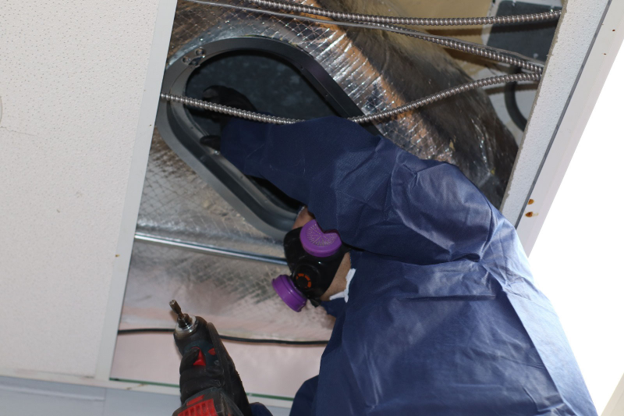
The core of the intervention is cleaning the ducts themselves. Depending on the system, this may include main ducts, secondary ducts, air returns and certain accessible sections of the network.
The goal is to remove dust, particles and deposits accumulated inside the ducts. Depending on the system configuration, the intervention may include specialized vacuuming, mechanical agitation or other methods adapted to the duct type and level of buildup.
Methods vary depending on:
- le type de conduits
- la longueur du réseau
- l’accessibilité
- the level of soiling
- la présence de poussière de chantier
- les contraintes d’occupation
- les zones desservies par le système
5. Dust capture
Professional cleaning should avoid simply moving dust from one area to another. Capturing particles is therefore an important part of the intervention.
Depending on the building and the network configuration, the intervention may include vacuum equipment, negative pressure when applicable, or other dust-control methods to limit particle dispersion. The goal is to remove particles from the network, not redistribute them into occupied spaces.
6. Post-intervention verification
Once cleaning is complete, a verification step helps confirm that the targeted areas have been treated and identify any additional recommendations.
Cette étape peut inclure :
- vérification visuelle des zones accessibles
- contrôle des grilles et diffuseurs
- observations sur l’état du réseau
- recommandations d’entretien
- documentation ou photos si requis
- conseils sur la fréquence des prochains nettoyages
Do you want to know what should be cleaned in your building?
Contact SDC Travaux Spécialisés to have your commercial ventilation system assessed.
Checklist: what professional cleaning should include
This checklist helps you quickly verify whether an intervention is complete or limited to visible surfaces.
| Élément | Why it matters |
| Inspection initiale | Comprendre l’état réel du réseau avant d’intervenir |
| Nettoyage des grilles et diffuseurs | Retirer les dépôts visibles aux points de diffusion |
| Nettoyage des retours d’air | Traiter les zones où les poussières peuvent s’accumuler |
| Nettoyage des conduits accessibles | Aller au-delà des surfaces visibles |
| Captation des poussières | Limiter la dispersion des particules pendant les travaux |
| Méthode adaptée au système | Tenir compte du type de conduits et de l’accessibilité |
| Vérification finale | Confirmer les zones traitées |
| Recommandations | Planifier l’entretien futur et les suivis nécessaires |
| Documentation si requise | Faciliter le suivi pour le gestionnaire ou le propriétaire |
This list also helps compare quotes. Two companies may offer different prices because the actual scope of work is not the same.
Partial cleaning or complete cleaning: what is the difference?
Not all duct cleaning services cover the same scope. Before accepting a quote, it is important to understand whether the intervention is partial, targeted or complete.
Vent-only cleaning
Vent cleaning removes visible dust around air outlets. It can be useful for appearance and basic maintenance, but it is not a complete cleaning of the network.
This type of intervention generally does not treat main ducts, air returns, internal network areas or deeper accumulations.
Targeted cleaning of one area
Targeted cleaning can be useful if the problem is limited to one section of the building, for example after work in a specific area or a localized accumulation. However, it is important to make sure the targeted area actually matches the observed problem.
Complete network cleaning
Complete cleaning involves a broader intervention on the ventilation system, depending on the available access points and building configuration. It may include vents, diffusers, air returns, main ducts and relevant secondary sections.
In a commercial or institutional building, this approach is often preferable when the system is dirty, several areas are affected or the network has not been cleaned in a long time.
Cleaning after renovations or a disaster
After renovations, water damage, a fire or another disaster, ducts may contain construction dust, soot, odours, humidity or other particles.
For this specific context, read our article on nettoyage de conduits de ventilation après rénovation.
Duct cleaning or HVAC maintenance: what is the difference?
Duct cleaning and HVAC maintenance are complementary, but they are not the same intervention. HVAC maintenance mainly targets the mechanical components of the system, while duct cleaning focuses on removing dust, deposits and particles from the air network.
| Élément | Entretien HVAC | Nettoyage de conduits |
| Objectif principal | Maintenir le fonctionnement mécanique | Retirer les poussières et dépôts du réseau |
| Zones ciblées | Unités, filtres, composantes mécaniques | Conduits, grilles, diffuseurs, retours d’air |
| Résultat recherché | Performance et fiabilité du système | Propreté du réseau et meilleure qualité d’air |
| Pertinence après rénovation | Utile, mais pas toujours suffisant | Souvent recommandé si poussière de chantier |
| Type d’intervention | Mécanique et préventive | Nettoyage spécialisé du réseau d’air |
A system can be mechanically well maintained but still have dirty ducts. Both interventions may therefore be necessary depending on the actual condition of the building.
When should air duct cleaning be considered?
Air duct cleaning may be recommended when the network shows signs of buildup, after work has been completed, or when a building has experienced a specific event such as water damage, a disaster or a long period without maintenance.
Signs that ducts may be dirty
Certain signs may indicate that an inspection is needed:
- poussière qui revient rapidement sur les surfaces
- odeurs persistantes lorsque le système fonctionne
- particules visibles autour des grilles
- traces de poussière sur les diffuseurs
- plaintes des occupants concernant l’air intérieur
- rénovation récente ou travaux poussiéreux
- système jamais nettoyé ou rarement entretenu
- zones mal ventilées
- historique de dégât d’eau ou d’humidité
These signs do not always prove that complete cleaning is required, but they justify a verification.
Contexts where cleaning is particularly relevant
Duct cleaning is often useful after:
- des rénovations
- des travaux de gypse ou de ponçage
- un réaménagement intérieur
- un dégât d’eau
- un incendie ou un sinistre
- une période prolongée d’inoccupation
- une accumulation visible de poussière
- des plaintes répétées des occupants
How do you compare an air duct cleaning quote?
An air duct cleaning quote should be clear about what is included. This makes it easier to compare offers properly and avoid unpleasant surprises.
Elements to verify before accepting
Before approving a quote, check whether it specifies:
- les zones inspectées
- les zones nettoyées
- le nombre de grilles ou diffuseurs
- les retours d’air inclus
- les conduits ciblés
- les accès nécessaires
- les méthodes de captation des poussières
- les horaires d’intervention
- building constraints
- la documentation fournie après les travaux
- les recommandations d’entretien
Questions to ask the company
To better compare offers, you can ask:
- Est-ce que les retours d’air sont inclus?
- Est-ce que les conduits principaux sont nettoyés?
- Est-ce que l’intervention se limite aux grilles visibles?
- Comment les poussières sont-elles captées?
- Est-ce qu’une vérification finale est prévue?
- Est-ce que des photos ou une documentation peuvent être fournies?
- Est-ce que les travaux peuvent être planifiés hors des heures d’ouverture?
- Quelles zones du bâtiment sont incluses dans le prix?
- Est-ce que l’intervention tient compte des contraintes d’occupation?
- Est-ce que des recommandations sont remises après les travaux?
A very low price can sometimes indicate an intervention limited to visible elements. Professional cleaning requires planning, adapted equipment, a good understanding of the network and a method that limits dust dispersion.
Key takeaway
Good duct cleaning should be clearly defined before work begins. The client should know what will be cleaned, how the intervention will be carried out and which areas are included.
How should the intervention be planned in a commercial building?
Duct cleaning in a commercial building is often more complex than in a residence. Systems are larger, schedules are more restrictive and spaces may be occupied by several groups of users.
In offices, schools, clinics, retail spaces and institutional buildings, occupants must be taken into account. Cleaning should be organized to limit dust, disruptions and discomfort.
Before the intervention, it may be useful to:
- identifier les zones problématiques
- fournir l’accès aux locaux techniques
- informer les occupants concernés
- dégager les accès aux grilles et diffuseurs
- planifier les travaux selon les heures d’occupation
- signaler les travaux récents ou sinistres antérieurs
- indiquer les zones sensibles ou équipements à protéger
- préciser les contraintes de sécurité ou d’accès
- informer le gestionnaire du bâtiment
- prévoir un point de contact sur place
Some buildings cannot easily interrupt their operations. The intervention may therefore need to be planned outside opening hours, by sector, in several phases or according to building priorities.
How much does professional air duct cleaning cost?
The price of professional air duct cleaning depends on the size of the building, the number of vents, the complexity of the network, the level of buildup and accessibility.
Two buildings of the same size may have different costs if one has a simple system and the other has a more complex network with several zones, floors or restricted access points.
Factors that influence price
The main factors are:
- superficie du bâtiment
- nombre de grilles et diffuseurs
- nombre de retours d’air
- longueur des conduits
- complexité du réseau
- accessibilité des zones techniques
- niveau d’encrassement
- présence de poussière de chantier
- intervention en dehors des heures normales
- besoin de documentation ou de photos
- type de bâtiment commercial, industriel ou institutionnel
To better understand rates, read our guide on the cost of air duct cleaning.
Is duct cleaning useful after water damage or a disaster?
Duct cleaning can be useful after water damage, a fire or a disaster if the ventilation network has been exposed to humidity, soot, odours, particles or contaminants.
After water damage, it may be relevant to check ducts, vents and air returns if humidity has affected areas close to the ventilation system. For this type of situation, read our article on what to do after water damage in a commercial building. ..
After a fire, odours, soot particles or residues can be found in some systems. A specialized intervention may then be necessary as part of disaster cleaning. disaster cleanup.
If fungal contamination is visible or suspected, ducts should not simply be cleaned without understanding the source of the problem. Fungal decontamination may be necessary if mould is present in affected materials or areas. mould decontamination .
When should you call SDC for duct cleaning?
It is recommended to call SDC when duct cleaning requires a structured approach adapted to a commercial, industrial or institutional building. The goal is not only to clean visible vents, but to understand the condition of the network and propose an intervention aligned with the building’s needs.
SDC can intervene in several contexts:
- bureaux
- commerces
- écoles
- bâtiments institutionnels
- immeubles multilogements
- entrepôts
- bâtiments industriels
- installations après rénovation
- bâtiments touchés par un sinistre
- environnements où les occupants signalent un inconfort
- bâtiments avec systèmes HVAC complexes
For an adapted intervention, see our commercial air duct cleaning service. Our commercial air duct cleaning service.
Do your ducts seem dirty, or has your building recently been renovated?
Contact SDC Travaux Spécialisés to schedule an assessment of your ventilation system.
What should you remember about professional air duct cleaning?
Professional air duct cleaning includes much more than simply dusting visible vents. It may include an initial inspection, site preparation, cleaning of vents, diffusers, air returns and ducts, dust capture and post-intervention verification.
In a commercial, industrial or institutional building, this intervention must be adapted to the system configuration, occupancy constraints and the actual condition of the network. Well-planned cleaning can help improve air quality, reduce dust buildup and support general building maintenance.
Need commercial air duct cleaning?
Contact SDC Travaux Spécialisés for a professional intervention adapted to your building.
What does professional air duct cleaning include?
Professional cleaning may include system inspection, site preparation, cleaning vents and diffusers, cleaning air returns, cleaning accessible ducts, dust capture and post-intervention verification.
How do I know if an air duct cleaning quote is complete?
A complete quote should specify the cleaned areas, included air returns, number of vents, targeted ducts, dust capture methods, intervention schedule and recommendations or documents provided after the work.
Does duct cleaning include air returns?
Not always. It must be confirmed in the quote. In a more complete cleaning, air returns should be considered because they can accumulate dust and particles.
What is the difference between partial and complete duct cleaning?
Partial cleaning may target only vents or one specific area. Complete cleaning covers a larger portion of the network, including vents, diffusers, air returns and accessible ducts depending on the building configuration.
Should ducts be cleaned after renovation work?
Yes, it is often relevant. After renovations, ducts may contain drywall dust, concrete dust, sawdust or other construction particles. Cleaning can help reduce the redistribution of these particles into occupied spaces.
How much does professional duct cleaning cost?
The price depends on the size of the building, the number of vents, the complexity of the network, the level of buildup and accessibility. An assessment is required to obtain an adapted price.
How long does duct cleaning take in a commercial building?
The duration depends on the size of the building, the number of areas to treat, duct accessibility, occupancy constraints and the scope of the intervention. Some work can be planned by sector or outside business hours to limit disruptions.
What is the difference between HVAC maintenance and duct cleaning?
HVAC maintenance mainly targets the mechanical components of the system, while duct cleaning focuses on removing dust and deposits from the air network. The two services can be complementary.